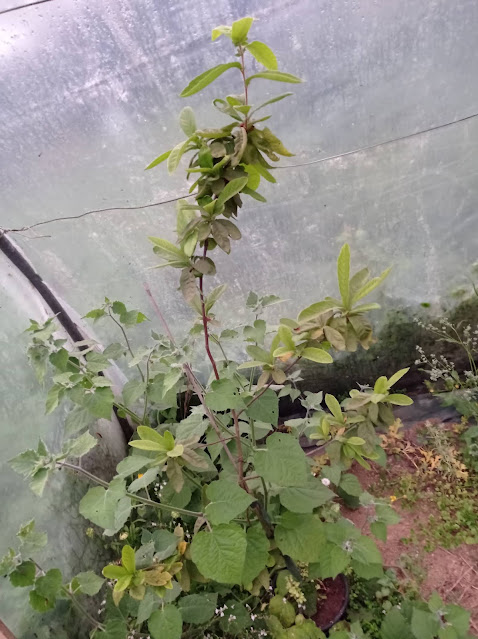
Mauka. Mirabilis expansa. I managed to grow two mauka varieties. Mauka blanca and mauka roja. I gave leaves to a friend of mine to try and eat them as spinach. He said they were moderately good and knowing him, if he says that, it means they are rather bad. I am trying to grow them through winter. The idea is to protect them from the frost so they might flower in january/february in order to get seeds. Mauka blanca Mauka roja.
Medlar. Mespilus germanica. I was lucky to get two very rare types of medlar. One kind was sent to me by a swiss collector who said it is the best tasting variety he knows. The second one is a seedless one that makes larger fruit than the ordinary seedless one, so also very special. There still is a huge potential in improving medlars through breeding simply by crossing them or even by trying to cross them with other fruit species. Medlars give fruit in my climate every year. No other fruit tree is as reliable for me as the medlar. superior tasting swiss type. large fruited, seedless type from bulgaria.
Malus sieversii. This is my little three coloured malus sieversii apple when it was young. Now i am trying to multiply it by approach grafting. The ornamental value of this tree is off the charts. Incredible leaf colours. This was at the end of last year. Now i am approach grafting it onto another apple rootstock. I did the grafting on the 6th of march and plan to cut them off on the 6th of june. In spring the leaves are green with a little red on the edges but each year they then display spectacular colours. The problem is the plant is not very vigourous and we don't know what the fruit will be like. Here you can see that the rootstock makes larger leaves than the three coloured apple. I found this individual in 428 seed-grown malus sieversii. Malus sieversii is incredibly diverse genetically as you can see in the next picture. These are malus sieversii seedlings displaying huge diversity.



Cool. Very, very, very cool.
ReplyDelete